

in Home Ownership, Mortgage News
Florida Amendment 3 (2026): What Homeowners and Buyers Should Know
Information reviewed November 12, 2026. Election results remain unofficial; implementation guidance is developing.
Florida homeowners and homebuyers may soon see changes to how much of a primary home’s value is subject to property taxes. Here’s what to know about the 2026 Florida Amendment 3, who may qualify for its larger homestead exemption, and why a change in taxes does not necessarily mean an immediate change in your mortgage payment.
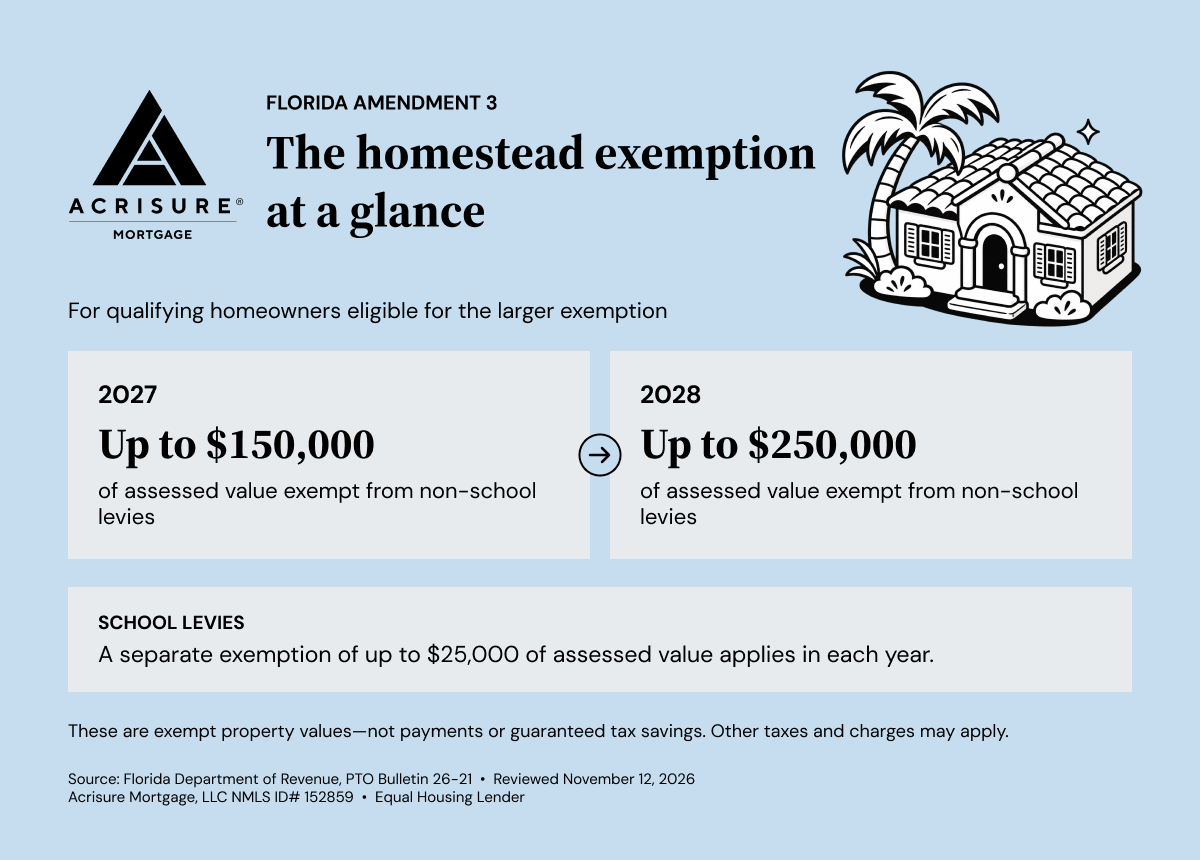
The short answer: Unofficial election results show that Florida voters approved Amendment 3. Beginning with the 2027 tax roll, the amendment increases the homestead exemption for certain non-school property taxes. For homeowners eligible for the larger benefit, up to $150,000 of assessed value is exempt in 2027 and up to $250,000 in 2028. These amounts are exempt property value, not cash payments or guaranteed tax savings. School taxes and other charges can still apply. Florida Department of Revenue; Florida Election Watch.
When does Florida Amendment 3 take effect?
The amendment takes effect January 1, 2027, and first applies to the 2027 tax roll. It does not change your 2026 property tax bill. The 2027 proposed tax notice is expected in August 2027, followed by the tax bill ordinarily issued in November 2027. You may be able to pay that bill in 2027; you do not have to wait until 2028. Leon County Property Appraiser; Florida Department of Revenue.
Election results were unofficial when this article was reviewed. Check Florida Election Watch for the latest status and your county property appraiser for updated guidance.
What do the $150,000 and $250,000 exemptions mean?
An exemption reduces the assessed value used to calculate certain property taxes. It is not a dollar-for-dollar reduction in your tax bill. Local tax rates are applied to the remaining taxable value, and different rules apply to school and non-school levies.
For a qualifying homestead eligible for the larger benefit:
| Tax year | Total exemption for non-school levies | Separate exemption for school levies |
|---|---|---|
| 2027 | Up to $150,000 of assessed value | Up to $25,000 of assessed value |
| 2028 | Up to $250,000 of assessed value | Up to $25,000 of assessed value |
Beginning in 2029, the larger non-school exemption amount is adjusted for positive inflation. Florida Senate analysis.
The non-school amounts are total exemptions for those levies; they are not added to the school exemption. The two calculations apply separately to the same property. Special assessments and other charges may remain. Your result depends on your home’s assessed value, other exemptions, local rates and fees. Florida Department of Revenue bulletin.
Who may qualify for the larger exemption?
The larger exemption generally applies to eligible homeowners who maintained permanent Florida residence as of December 31, 2026, and meet the residency and homestead requirements for the property. Eligibility is subject to final implementation guidance and the county property appraiser’s determination. You do not necessarily need to have owned your eventual home by that date. For example, someone who qualifies as a Florida permanent resident while renting in 2026 may later buy a home and apply for homestead. Renting alone does not provide the owner’s exemption. Florida Senate analysis.
The general homestead exemption does not have a household-income ceiling, though separate senior or other exemptions can have their own requirements. Ask your county property appraiser about eligibility, documentation and whether you need to take action.
What if I move to Florida in 2027 or later?
For someone who did not maintain permanent Florida residence as of December 31, 2026, but otherwise qualifies for homestead, the initial exemption is up to $25,000 of assessed value for school levies and up to $50,000 for non-school levies. The latter is adjusted for positive inflation beginning in 2028. The larger exemption begins with the fifth year of exemption, subject to applicable rules and constitutional requirements. Florida Department of Revenue bulletin.
For example, if 2027 is your first qualifying exemption year and the applicable requirements continue to be met, 2031 would be your fifth year. Ask your appraiser how moves, interruptions or joint ownership affect your circumstances; further guidance is expected.
How could Amendment 3 affect my mortgage payment?
If your mortgage servicer collects property taxes and homeowners insurance through an escrow account, your monthly payment generally includes an amount for those costs in addition to principal and interest. A lower expected property tax bill could eventually reduce the escrow amount, but the timing and amount depend on your servicer’s analysis. Insurance costs, the account balance, any shortage or surplus, and the permitted cushion also matter. Consumer Financial Protection Bureau.
Amendment 3 does not itself change your loan balance, interest rate or principal-and-interest obligation. If you pay property taxes directly, there is no property-tax escrow collection to adjust, and you remain responsible for paying the tax bill. Your servicer may still collect other costs, such as insurance, through escrow.
Questions to ask your servicer: When is my next escrow analysis? What tax and insurance amounts are currently estimated? Is there a shortage or surplus? Continue making your required payment unless your servicer confirms a change.
A simple property tax example
Suppose a home eligible for the larger exemption has an assessed value of $300,000 in both 2027 and 2028. Assume a combined non-school rate of 12 mills and a school rate of 6 mills. One mill is $1 per $1,000 of taxable value. These rates are fictional, and the example assumes no other exemptions, fees, special assessments, discounts or changes in value or rates.
| Year | Non-school tax | School tax | Illustrative total |
|---|---|---|---|
| 2027 | ($300,000 − $150,000) × 0.012 = $1,800 | ($300,000 − $25,000) × 0.006 = $1,650 | $3,450 |
| 2028 | ($300,000 − $250,000) × 0.012 = $600 | ($300,000 − $25,000) × 0.006 = $1,650 | $2,250 |
Under these fixed assumptions, the difference is $1,200 for the year. Your actual bill may be different, and this is not a prediction of your monthly escrow payment or a comparison with your 2026 bill.
This example is hypothetical and assumes the homeowner qualifies for the applicable exemptions. Actual property taxes and savings will vary based on eligibility, assessed value, local tax rates, and other applicable factors. This is not a guarantee of future tax savings or reduced mortgage payments.
What should Florida homebuyers and movers consider?
Don’t rely on the seller’s tax bill as your estimate. The seller’s exemptions and assessment limits do not automatically become yours, and a change in ownership may affect the property’s assessment. Ask the county appraiser for a buyer-specific estimate and your loan officer which tax amount is being used in your financing estimate. Property taxes can be part of the housing costs considered for a mortgage, but a lower estimate does not guarantee approval or a particular loan amount. Florida Department of Revenue: portability FAQ; Fannie Mae Selling Guide.
Ask about portability if you’re moving from another Florida homestead. Your homestead exemption itself does not transfer, but eligible owners may apply to transfer some or all of their Save Our Homes assessment difference, subject to limits and deadlines. Your county appraiser can explain how to apply.
When you get closer to closing, our guide to reading your Closing Disclosure can help you review the estimated costs associated with your loan.
What about renters and other properties?
Renters do not receive the owner’s homestead exemption simply by renting. The amendment also reduces the assessment-increase limit from 10% to 5% for certain non-homestead property for non-school levies. This is a limit on covered assessed-value increases, not a 5% tax rate or a cap on the total bill. It does not guarantee a change in rent. Florida Senate analysis.
Larger exemptions may provide relief to eligible homeowners while changing the taxable value available to support local budgets. Future effects on rates, fees and services will depend on local decisions and other conditions.
What should I do next?
- Confirm your homestead status. Contact your county property appraiser about eligibility, residency documentation and whether an application is needed. March 1 is the usual application deadline; ask about exceptions and updated forms.
- Watch for your 2027 notice and bill. Review the proposed TRIM notice expected in August and the bill ordinarily issued in November. Your tax collector can explain payment dates and options.
- Review your escrow statement. Ask your servicer how updated taxes and insurance may affect your next analysis. If you pay taxes directly, plan for the bill yourself.
- Plan ahead if you’re buying. Ask the appraiser for a property-specific estimate and discuss your overall monthly housing costs with your loan officer.
Frequently asked questions
Did Florida Amendment 3 eliminate property taxes?
No. School taxes may still apply, as may non-school taxes, special assessments and other charges. Your bill depends on your property and local rates.
Is the $250,000 exemption a refund?
No. For eligible homeowners, it is the maximum amount of assessed value exempt from non-school levies in 2028—not a payment or a promise of $250,000 in savings.
Will my mortgage payment fall in January 2027?
Not necessarily. If your taxes are escrowed, your servicer’s analysis and other costs determine whether and when the escrow portion changes. The amendment does not itself change principal and interest.
Does the 5% limit cap my homestead tax bill?
No. The 5% limit applies to certain non-homestead assessed-value increases for non-school levies. The separate Save Our Homes limit for homesteads generally remains the lower of 3% or inflation, subject to exceptions. Neither is a guaranteed cap on the total bill. Enrolled amendment text.
Have questions about how property taxes fit into your homebuying budget? Connect with an Acrisure Mortgage loan officer to talk through your financing options. For exemption eligibility or tax advice, contact your county property appraiser or a qualified tax professional.
This article is for general informational and educational purposes only and is not intended as tax, legal, or financial advice. Information is based on Florida Amendment 3 and available guidance as of November 12, 2026. Implementation requirements and eligibility guidance may change. Actual property taxes and potential savings vary based on individual circumstances, property assessments, local tax rates, and applicable exemptions. Examples are hypothetical and do not guarantee tax savings, reduced mortgage payments, or loan approval. Please consult your county property appraiser or a qualified tax professional regarding your specific situation.
About Acrisure Mortgage
Acrisure Mortgage (formerly FBC Mortgage, LLC) is a Top 10 national mortgage lender headquartered in Orlando, Florida. Licensed in 49 states and supported by more than 19,000 dedicated professionals across Acrisure, we specialize in residential mortgage lending through both retail and wholesale/correspondent channels. Our comprehensive offerings include purchase, refinance, construction and renovation loans—tailored to meet the unique needs of homebuyers, homeowners and partners nationwide.
We are proud to serve as a trusted partner to many of the nation’s largest homebuilders and real estate professionals, with a strong foundation of loyal, satisfied clients. Recognized for our commitment to service, innovation and operational excellence, Acrisure Mortgage has received numerous national accolades, including Top 50 Mortgage Companies, Best in Loan Delivery and Best Place to Work honors.
As part of the Acrisure family, we are backed by a global fintech leader that shares our values of innovation, integrity and service. Together, this empowers us to expand our capabilities, leverage world-class technology and resources, and grow alongside the clients and communities we serve.
All information presented is for educational purposes only and not intended as financial advice. NMLS ID#152859 EHL ©2026.